EXHIBITIONS
September 19, 6pm-8pm
Exhibition Opening + Festival Reception
Bracken Hanuse Corlett, Jessica Silvey + Robert Joe, Laiwan and others
Water Wings for the Big Waves
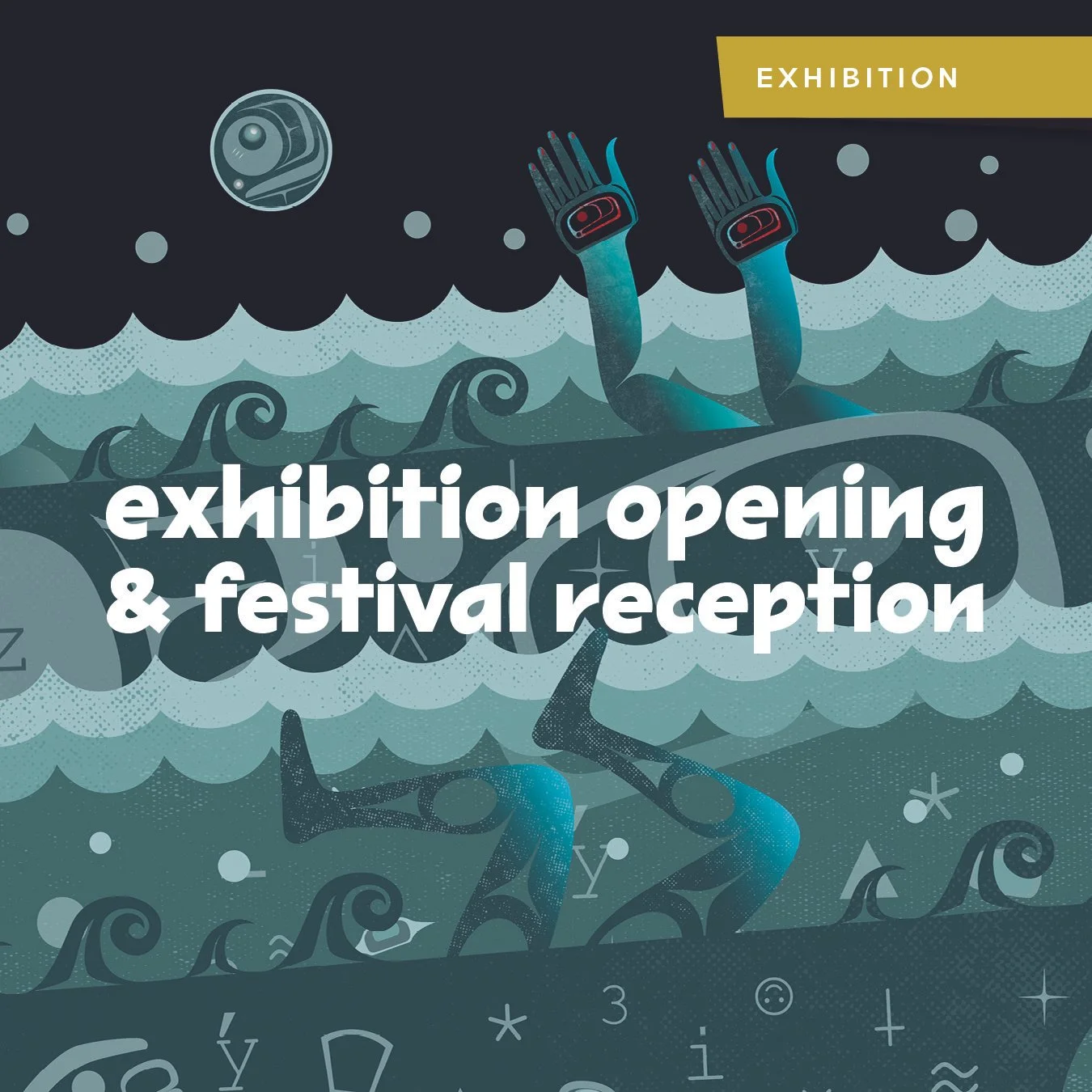
Bracken Hanuse Corlett
Up and down the pacific northwest coast there are stories shared of the great flood. They speak about the rising waters, the urgency to escape to higher ground and coming down to start over again after the water recedes. In my home community, Wuikinuxv, it is said the People who survived the flood climbed the mountain known as Kvauma (seat of the eagle) to escape the push of the ocean water. In making a lot of the work for this show I was thinking about the art we make and the work we do after loss...after a series of losses. What happens when catastrophe and heartbreak are normalized in our bones? Where do we place focus? Do we look at what has been taken, or to what remains and can be reclaimed?
Bracken Hanuse Corlett is an interdisciplinary artist from the Wuikinuxv and Klahoose Nations. He works in painting, sculpture, audio-visual performance, digital art/design, animation and narrative. He graduated from the En'owkin Centre of Indigenous Art and went to Emily Carr University of Art and Design. He also trained at the Hunt Studio with renowned Heiltsuk artists Bradley Hunt and his sons Shawn and Dean. A recent winner of the 2022 Portfolio Prize and the 2022 Joseph S. Stauffer Prize in Visual Arts, he maintains a studio and collaborative practice working with ancestral forms and new media. He has exhibited, screened and/or performed locally and internationally with some notable work at VIFF, Vancouver Art Gallery, Winnipeg Art Gallery, TIFF, and the Institute of Modern Art.
Great snow, floodwaters and other stories
Robert Joe and Jessica Silvey
shíshálh oral narratives describing the great flood, the great snow and the great landslide speak to significant events in the collective history of the shíshálh swiya. According to one, a global cataclysmic flood occurred, impacting the swiya. The shíshálh people survived the flood by using their canoes to form a raft and anchoring their canoes to an uprooted Yew tree that floated to the top of kel’s mountain (“Anchor Mountain”). When the flood receded, the tree wedged itself to the mountain and remained there for a long time. This soundwork shares these and other stories and recollections.
Elder Robert Joe led the Nation’s rights and title department. As litigation coordinator, he assembled a team of experts, among them an anthropologist, archeologist and historian, to develop, collaboratively, a case “that we owned the land, we defended the land and we used the land.” Jessica Silvey is a shíshálh artist, weaver and storyteller. Her practice is a reminder of the remarkable craftsmanship, cultural continuity and deep relation to land that is central. From harvesting cedar from the surrounding mountains, to gathering the dye and medicine plants, Silvey’s work expresses her intimate and profound relationship and knowledge of the plant-kin that shape this place.
How Water Remembers
Laiwan
How Water Remembers explores how biodiversity and cultural diversity remembers, a flow of a way of life, a return of ancestral worldviews, traditional knowledge and stewardships, training an agile consciousness. We can highlight and daylight other ways of knowing that had once been invisible underground networks, in the same way underground streams are daylighted and recovered for fish, phytoplankton and numerous critters to once again find their way home. It invites us to play, build compassion and build awareness and cultural value in developing sustainable ecologies for humans and biodiversity. By increasing ecological biodiversity, scientists believe we can slow down global warming and also increase protections against future pandemics. How do we revitalize biodiversity within a city and nourish biodiverse ecologies in our everyday?
The image of 龍母 [Dragon Mother] is inspired by the background map “showing the areas, in dark blue, that are vulnerable to flooding due to a major storm (1:500 year storm) today, and areas in light blue that are vulnerable to flooding due to a major storm and 1 metre of sea level rise by 2100 without flood management measures in place” (quoted from Vancouver’s Changing Shoreline, City of Vancouver, 2018.)
Laiwan is an interdisciplinary artist, writer and educator with a wide-ranging practice based in poetics and philosophy. Born in Zimbabwe of Chinese parents, her family immigrated to Canada in 1977 to leave the war in apartheid Rhodesia. Her art training began at the Emily Carr College of Art & Design (1983), and she returned to academia to receive an MFA from Simon Fraser University School for Contemporary Arts (1999). Recipient of numerous awards, including the 2023 VIVA Award, 2021 Emily Award from Emily Carr University, recent Canada Council and BC Arts Council Awards, and the 2008 Vancouver Queer Media Artist Award, Laiwan served on numerous arts juries, exhibits regularly, curates projects in Canada, the US, and Zimbabwe, is published in anthologies and journals, and taught for twenty years at the MFA in Interdisciplinary Arts Program at Goddard College (VT/WA, USA). She is based on the unceded ancestral territories of the Musqueam, Squamish, and Tsleil-Waututh First Nations and currently works in the Department of Arts, Reconciliation and Culture at the Vancouver Park Board.